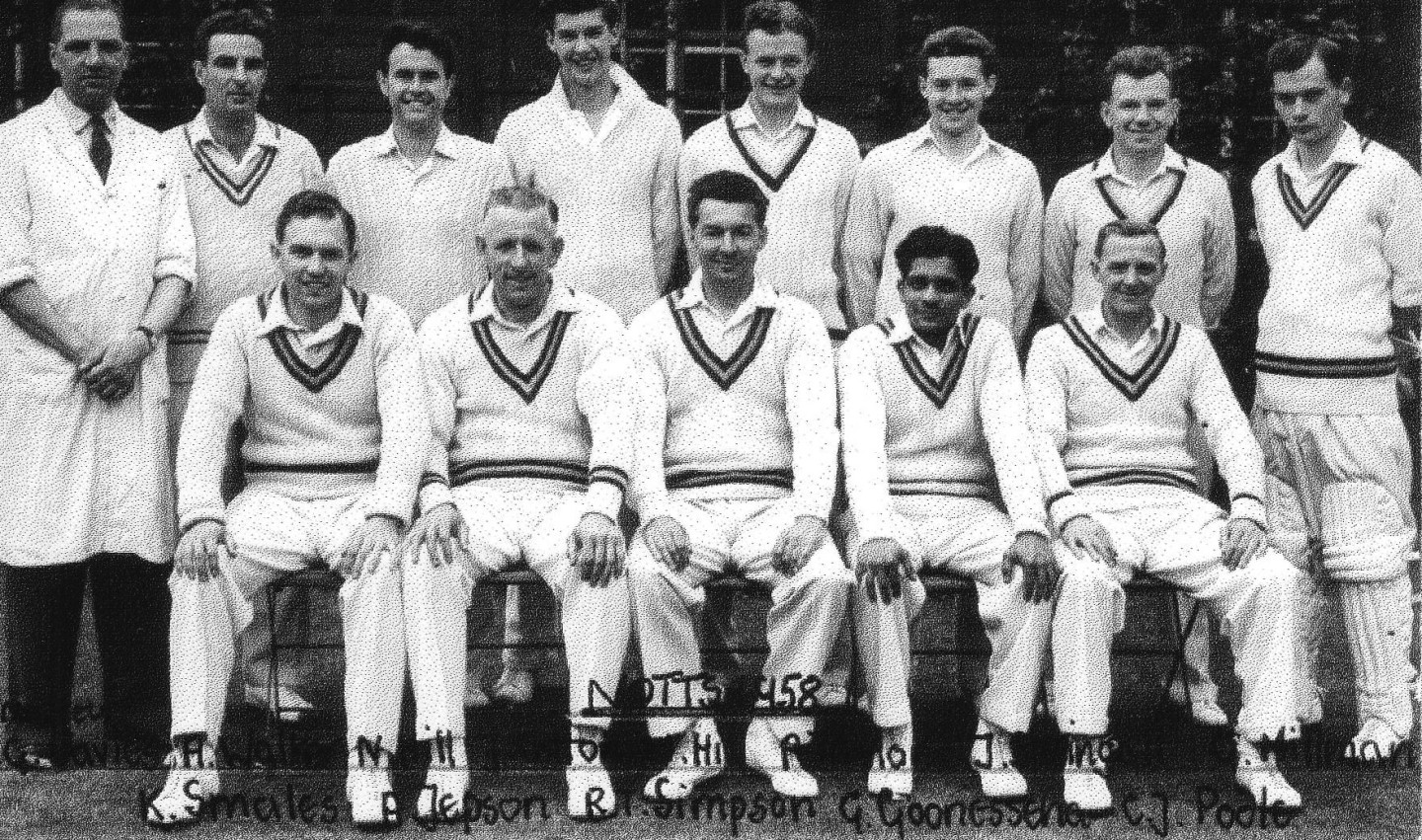
County Championship 17th (last) W3, D8, L15, A1)
Captain Reg Simpson
The 1958 season was one of the worst in the club’s long history, as – apart from the weather which interfered with many games – the side finished at the bottom of the County Championship table, a position last occupied in 1951.
Reg Simpson captained the side and seemed to have recovered from the back injury which kept him out of so many games the previous season. Along with Cyril Poole, Norman Hill and Maurice Hill, he scored over 1,000 runs in a season which was not entirely favourable to batsman.
Of the bowlers, Arthur Jepson and Ken Smales were the most successful. At 43 years of age, Jepson took more wickets than anyone else, one of the best performances of his career being 8 for 45 against Leicestershire at Trent Bridge; but even his Herculean effort could not prevent a win for the visitors by 81 runs.
The Leicester game came towards the end of the summer and was in keeping with much that had gone before. Notts lost five of the first six matches in the Championship; the sole victory was by six wickets against Hampshire at home.
John Cotton, a bowling all-rounder, made his debut in the opening fixture, away to Middlesex at Lord’s, a match in which Notts rallied well but to no avail. Having been dismissed for 95 in the first innings, they recovered to made 340, following on but Middlesex were comfortable chasing the 183 needed, which they did with 2 wickets to spare.
In the home game with Glamorgan, Notts again subsided in the first innings, making just 88; the Welshmen eased home by five wickets, making 113-5 in the second innings.
Away to Sussex, Notts did make a rather better start to the match, making 287 all out and claiming a first innings lead of 24. Cyril Poola, 116no, made the county’s first century of the season but it was not enough to prevent Sussex winning by eight wickets.
Essex came to Trent Bridge and with 342-7 dec, based around Gordon Barker’s 157, won comfortably by an innings and 112 runs. It was a similar story when Surrey, who would duly clinch their seventh successive Championship, visited Nottingham.
A first innings of 334-4 – Peter May 163 – was more than enough and the visitors won by an innings and 43 runs. Tony Lock took eight wickets in the match, including his 1400th scalp. Paul Taylor, who had debuted with Cotton at Lord’s made his sixth and final First-Class appearance in this game.
Nottinghamshire then went undefeated for eight games, one of which (away to Yorkshire at Hull) was abandoned completely. Of the drawn games, mostly due to the wet weather, the game against Worcestershire at home saw the final First-Class match for Aussie seamer Alan Walker, whose 221 First-Class wickets included his remarkable four-in-four balls against Leicestershire in 1956.
Highlight of the Kent match was a 310 run second wicket partnership between Arthur Phebey (122) and Colin Cowdrey (139). The matches home and away with Lancashire were both drawn and in both there was no play possible on the third day.
Rain turned the home fixture with Yorkshire into a single innings match – played on what should been the third and final day – but a definite result was still not possible. The weather was unrelenting and away to Essex at Colchester, the loss of day one ensured another draw. Michael Hall, son of John Hall, who had played for Notts either side of WWII, made his debut in the Essex game.
Notts broke the sequence of damp draws with a home win – by six wickets – over Northamptonshire; the visitors made 94 and 158, Notts 170 and 83-4. This was something of a false dawn as Notts failed to win any of the next eleven matches.
Norman Hill made 153, the highest innings for any Notts batter in that summer, at home to Kent but, led by Colin Cowdrey’s 117, the Southern county won by nine wickets. First innings points, incidentally, went to Kent by a single run – 343 to Notts 342.
Seven wickets apiece for Gloucestershire’s Sam Cook and Nottinghamshire’s Ken Smales were the outstanding performances in a draw at Gloucester. Notts then went on a losing run – seven of the next eight games ended in defeat.
Northants got their revenge, winning by 10 wickets at Northampton, thanks largely to 139 from Des Barrick. The next three matches all ended in an innings defeat.
Derbyshire won courtesy of five wickets from ‘Dusty’ Rhodes (who spent a couple of seasons with Notts before re-joining Derbyshire) and 137 from Charlie Lee. Hampshire also reversed the result of the earlier game, dismissing Notts for 100 and 294, to win by an innings and 22; the standout partnership was between the great West Indian opener Roy Marshall (138) and Jimmy Gray (154), who put on 186 for the first wicket.
In the next match, Derbyshire did the ‘double’, winning by an innings and two runs having won the previous match by an innings and 88. Given that the home side only made 158-8 dec, it shows what a poor effort Notts put in, dismissed for 84 and 72, Cliff Gladwin with eleven wickets in the game.
Mike Hill’s maiden century, 103, and John Cotton’s 6-56 helped Notts eke out a draw against Warwickshire. Notts lost at The Oval to champions Surrey but dismissed the home side for 153 (Cotton with five wickets); however, innings of 142 and 106 meant that Surrey won with some ease, making 96-2.
Another low scoring game, and yet another example of Notts failing to reach 100 in their first innings, ended with Somerset victors by nine wickets.
Against Leicestershire, Ken Smales took 5-59 in his final match for Notts but could not prevent a win for the East Midlands rivals by 61 runs. Ken Smales played 161 First-Class games for Nottinghamshire, taking 389 wickets – among them his record-breaking 10-66 against Gloucestershire in 1956.
There was no play on the first day of the game with Warwickshire which predictably ended in a draw, as did the match versus the New Zealand tourists.
In the return against Leicestershire, Notts won, and by a large margin – an innings and 33 runs – to confound their form of most of the season. Gamini Goonasena, with 6-19 and 7-63 was the architect of this rare success.
Back at Trent Bridge, Notts lost by an innings and 73 runs to Sussex, thanks primarily to 178 from Ken Suttle. The last match of the season also ended in a loss, as Somerset won by five wickets.
Mid-season, in July, that great player of the past, George Gunn, passed away suddenly. To quote Neville Cardus, ‘he was the most original of great batsmen, a law unto himself. The modern way of estimating a cricketer’s talents by statistics, records and averages, tells only half of the truth about him. He was the best of all batsmen against fast bowling. He celebrated his 50th birthday in 1929 by scoring 164 not out and told me weeks in advance of the date how he would celebrate it. Whether scoring or not, he was a delight to watch, never awkward, never at the bowler’s orders. His strokes seemed to be made by a bat through which, from handle to blade, some current of his personality travelled. We shall not in a hurry look on his like again’.
In a change to the back-room staff, Frank Shipston, a former Nottinghamshire player, was appointed Coach. It was also announced that H A Brown had retired as Secretary of the club, a position he had occupied since 1921.
February 2026
Scorecards and stats can be seen here