THE FIRST SUMMER OF FIRST-CLASS CRICKET…
200th Anniversary in 2026
This summer of cricket promises to be full of special events and special times – Notts are defending champions, new overseas stars will join us, the exciting new Pavilion re-fit will be revealed…and we celebrate two hundred years of First-Class cricket.
In July 1826, a team from Nottingham travelled to take on a combined Sheffield-Leicester XI; at that time, there was no ‘First-Class’ designation for games but in 1895 the game’s authorities introduced the category; however, past games were not reviewed at that time.
Matches of sufficient importance – including the game at the Darnall ground, Sheffield, in 1826 – were eventually classified as First-Class by the Association of Cricket Statistician and Historians (ACS).
The essential shape of the 1826 game would be familiar to modern cricket fans – the Laws of Cricket (note, Laws, not ‘rules’ and always with a capital L) were already in their third version – but with underarm bowling and four-ball overs.
Even so, the match would not have looked very much like the county game of today.
The idea of 19th Century cricket brings visions of Grace and Shrewsbury, Shaw and Spofforth, but that’s half a century on. Indeed, two of the great men of the Victorian Age – George Parr and John Wisden – were newborn in 1826.
This was not Victorian Cricket, this was Regency Cricket.
Think Jane Austen, not Dickens…think the Royal Pavilion, not the Trent Bridge Pavilion.
Indeed, Austen does have at least one reference to the great game in her works: At the start of Northanger Abbey, the great chronicler of Georgian manners and society fleshes out the character of heroine Catherine Morland as a young girl observing that she was ‘fond of all boys’ play, and greatly preferred cricket, not merely to dolls but to the more heroic enjoyments of infancy.’
Quite what those ‘more heroic enjoyments’ might be is hinted at a page or two later when Catherine is said to ‘prefer cricket, baseball [!!] riding on horseback and running about the countryside’ to books.
Regency Nottingham was a town – city status was 70 years in the future – growing with the Industrial Revolution. Framework Knitting was one of the first industries to establish itself in Nottingham and surrounding areas; more traditional trades such as tanning were beginning to decline and, in the North of the County, coal mining and export – often via the still recently developed canals – was the principal business.
Canals were the commercial arteries and mechanisation was coming to the workplaces but for most people, and Nottinghamshire was still a primarily agricultural county – the foremost means of transport was the horse.
‘Riding on horseback’ like Catherine Mansfield or travelling by cart, wagon, mail coach, stagecoach or, for the very grand, carriage was the order of the day.
Those eleven men from Nottingham Cricket Club, their supporters and backers, probably travelled by horse and carriage to Sheffield, a journey both lengthy and uncomfortable (railways didn’t arrive for another 13 years – and then only to Derby).
That’s not a quick nip up the M1. And it would have seemed even more wearying as Nottingham subsided to a heavy defeat – by an innings and 203 runs.
Regular Mail Coaches plied to and from Nottingham, with the 'Herald' Mail coach connecting London to Glasgow via Nottingham, Chesterfield, Sheffield and Carlisle. In 1826, it would likely have taken around 1 to 2 days (perhaps 10-20 hours of travel), depending on road conditions, speed, and stops for meals and rest.
The match started on Monday, so journeying probably started the preceding Saturday. Certainly, their Leicester opponents would have had an even more arduous journey.
The main route up the country was the Great North Road, which went through Newark, not Nottingham, but even that would not have been a bitumen or tarmacked road. The first tarmac road was not laid until 1902 – ironically, along the Radcliffe Road right outside the Trent Bridge ground.
Players in the Nottingham team came from places which were then outside the Town. The total Town population in 1821 was 53,000, which grew to 76,000 only ten years later; that includes those living in the areas of Radford, Bulwell, Sneinton and Basford, which only became part of the Town in 1877!
Thus the side that played as ‘Nottingham’ in 1826 was really a Nottinghamshire eleven. The first time that Nottinghamshire appears as an eleven in its own right is three years later in 1829 when Nottingham met Nottinghamshire on The Forest. Four of the ‘Nottingham’ team of 1826 were in the county side and two represented Nottingham – plus Emmanuel Vincent, who in 1826 had been in the opposing eleven.
The first inter-county match took place in 1835 between Nottinghamshire and Sussex, also on The Forest. Three years later, William Clarke laid out his ground at the back of the Trent Bridge Inn to begin the long history of Trent Bridge.
Actually, there is one earlier instance of the county name appearing – in 1803 a combined Nottinghamshire and Leicestershire XI played Hampshire at Lord's, losing by an innings and 20 runs (these early games do not pan out well, do they?)
Lord Frederic Beauclerk, who had never played for either county, led the combined eleven and top scored in both innings. Wealthy ‘amateur’ patrons such as Lord Frederick backed many teams in the South but in the North and the Midlands, players were more likely to be self-financed or sponsored by local businesses (often publicans).
Betting played a significant part too. For the 1826 match the purse – huge for those times – was 200 sovereigns (a tad over £25k in today’s money), which might account for the estimated 25,000 spectators over those three days.
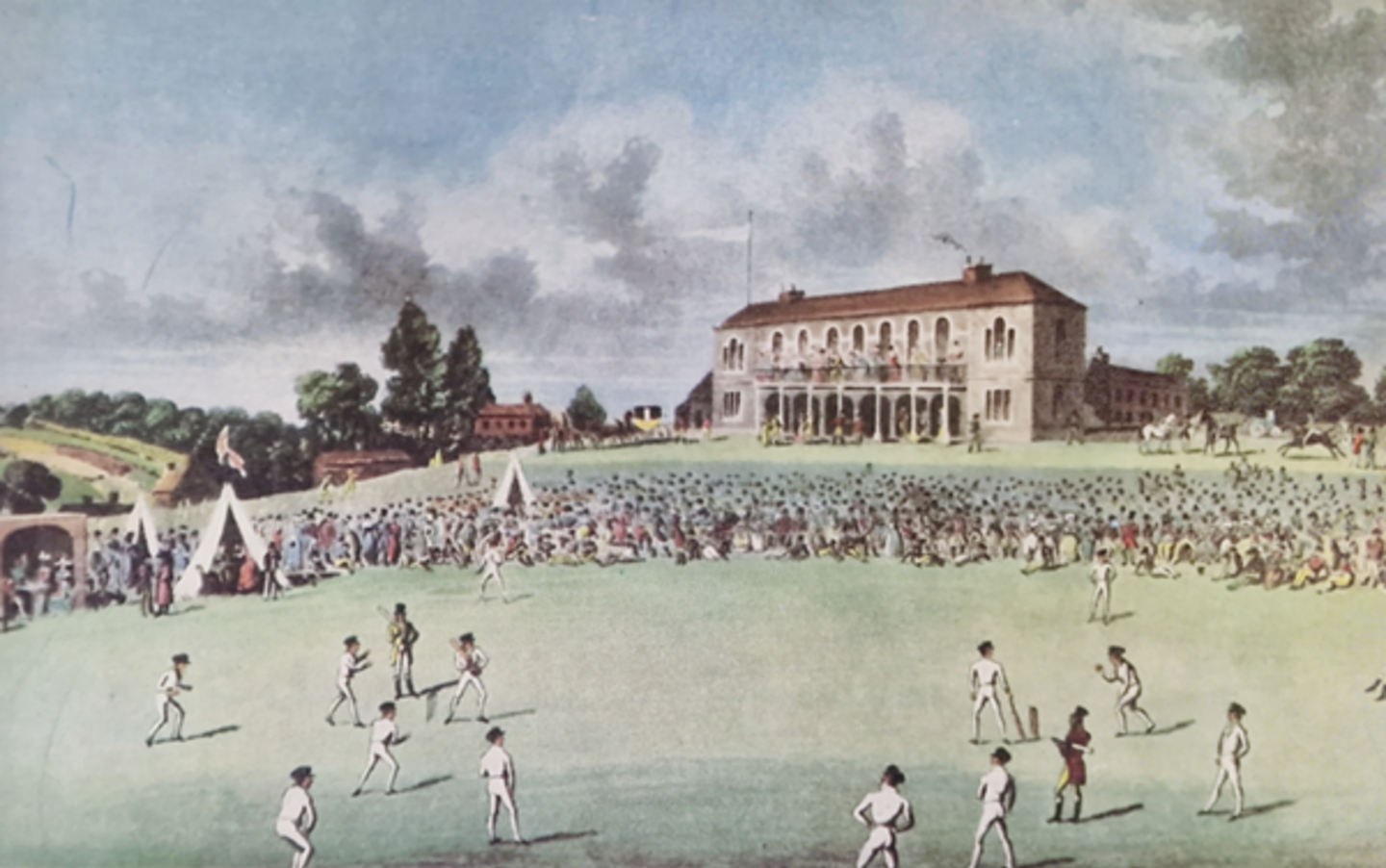
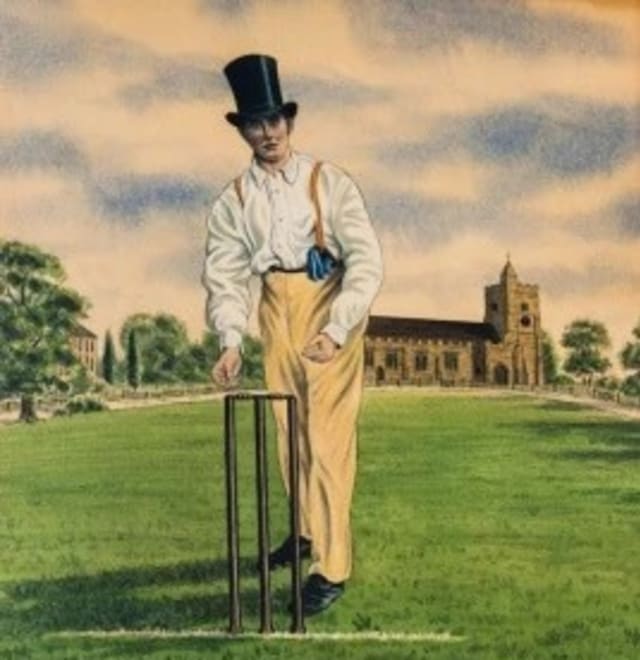 There are no images of the 1826 game, though we do have a sketch of William Clarke who played in that game, and another of the Darnall ground; other sketches and paintings give a fair idea of how the game may have looked. (The illustration is of the Village Sign of Benenden in Kent)
We do not know if Nottingham had a standard playing kit – certainly no ‘green and gold’ – white would have been the predominant colour, but with an assortment of colours and accessories, including large and seemingly unstable hats.
Twenty-first century traditionalists that decry the idea of players in motley clothing playing for large sums of money before noisy and unruly crowds might find it hard to recognise that the Regency game had more than a passing resemblance to the modern one.
The mention of a lack of images prompts thoughts of other developments in 1826 – including the world's first photograph, produced by Joseph Niepce. It was taken from a window of his Le Gras estate at Saint-Loup-de-Varennes, France, by exposing a bitumen-coated pewter plate in a camera obscura. It took an exposure time of eight hours.
Other events that give some context to the Regency Cricket would include a General Election in which the Tories (under Lord Liverpool) won a landslide victory. The Borough of Nottingham was in the Whig camp, while the County was more influenced by Tory, anti-Catholic, sentiment.
There was a heat wave that summer – with many days recording 'highs' of 32C (90F); the highest temperatures recorded in Nottinghamshire until 1975.
The Heritage team at Trent Bridge are working ideas for lunchtime or teatime talks and exhibitions or displays during the coming season to tell the full story of the 1826 match and the players involved – look out for announcements as the season progresses.
This article is based on others that appear in the Spring 2026 issue of Covered, the Notts CCC members’ magazine and in the 2026 edition of the Nottinghamshire Cricket Annual, now on sale at the Trent Bridge shop for just £10.
More articles will follow as we mark this important anniversary, on the match itself, the players of 1826 and a look at the two great cricketers, Parr and Wisden, born in that year.
April 2026