ROGUES OR SUPERSTARS?
Barnes and Close at NCLS
Two players separated by seventy years but sharing a reputation as a maverick in the game were the subject of talks at the November meeting of the Nottingham Cricket Lovers Society (NCLS), held at Trent Bridge.
Billy Barnes – who made his Nottinghamshire debut 150 years ago – was brought to life by his great-grandson Andy, who told tales of his ancestor who was, he suggested, both ‘a superstar and a rogue’.
The same could be said about Brian Close, one-time skipper of Yorkshire, England and Somerset and a player whose robust approach to the game of cricket – indeed to life in general – is best summed up in the title of Stephen Chalke’s latest book ‘One Hell of a Life’.
Both men played the game their way and fell foul of the authorities on more than one occasion. Andy Barnes explained some of his great-grandfather’s misdemeanours:
“Many Captains”, he said “quoted his hard drinking style and associated behaviour. Once, having been criticised by the Notts committee for his drinking, he then went and scored a match-saving century, suggesting, pointedly, that the committee members might like to go out and do similar.”
On another occasion, he missed his train, arrived under influence, and missed the start of the match. A written warning followed of ‘no further selection’ if repeated.
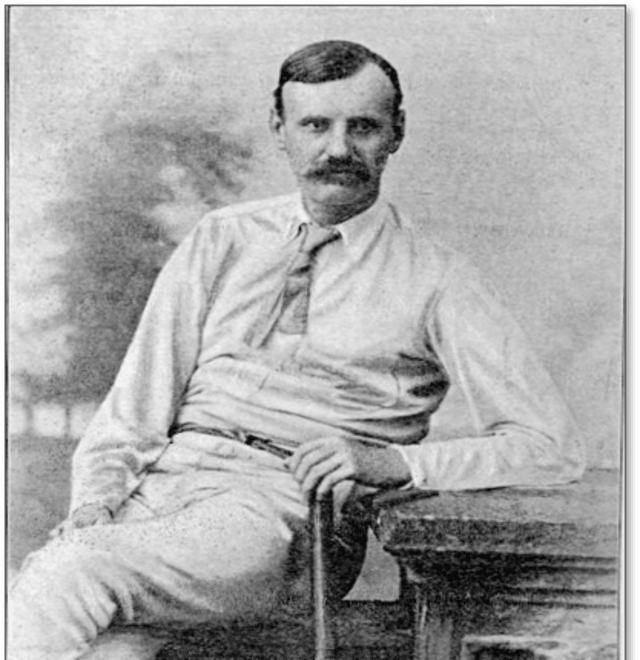 “On the 1886/87 tour of Australia, Billy injured his hand when swinging for the Aussie Captain Percy McDonell but hit the wall instead and couldn’t bowl”, Andy said.
“He also hurt his hand in a disagreement on board ship over a cards game, which prevented his selection for the first tour match in Australia.
“On the 1884/85 tour, he refused to bowl in Sydney, joining two other professionals demanding that the offered £5 match fee was increased to £10. He succeeded but didn’t exactly endear himself to the authorities”.
Billy Barnes was born in Sutton-in-Ashfield in 1852 and his first cricketing appointment was for the Winchester Garrison but he soon came to the attention of his home county and played for Notts from 1875 to 1894. From 1895 until retiring from playing in 1898, he was on the MCC ground staff and even tried his hand at umpiring – an unlikely move for one who had a reputation as being argumentative and even occasionally brawling!
Although Notts were his main employer, Andy pointed out that Billy played over 450 First-Class games, of which 257 were for his home county. He finished with a batting average of 23.2 with 21 centuries. If that seems meagre by 21st century standards, Andy was at pains to stress just how good his ancestor was.
“Apart from WG Grace, and Billy’s Nottinghamshire team-mate Arthur Shrewsbury, centuries were still quite rare and an average in the twenties was reckoned to be a sign of a good player”.
So good was he that in 1880, Billy Barnes became the first Notts player to make 1,000 First-Class runs in a season.
Add to that his more than useful bowling – 902 wickets at 17.10 with 10 ten-wicket matches and a 45 ‘five-fers’ – and it is easy to see why, despite his roguery, Andy Barnes called his great-grandfather a ‘superstar’ and said:
“I never met my Great Grandad – but I wish I had!”
Stephen Chalke did meet Brian Close, and many of the other cricketers that he spoke to when compiling his new, and award-winning, book.
If Close was less of a rogue that Billy Barnes – DBC would never have turned up for a match the worse for drink – he could certainly match the Victorian for scrapes with the cricketing hierarchy.
Close, too, is a player whose prodigious talents are not truly reflected in his career stats but, as Stephen Chalke explained: “Closey always played for the team, not his own figures. If rapid runs were needed, he would sacrifice his own wicket in pursuit of those runs."
Indeed, one of his most famous – or notorious, depending on your view – episodes was when playing for England against Australia at Old Trafford and battling to save the game, he decided to hit out at the chief tormentor, Aussie skipper Richie Benaud.
Close was attempting to knock the spinner ‘off his length’ but perished before he could do so and was roundly condemned for his perceived ‘recklessness’; it didn’t seem to matter that Benaud himself acknowledged that had Close survived for an over or two more, Richie would have been obliged to take himself off. It cost him his place in the side for the next Test.
Stephen Chalke made the point that Close was not always ‘reckless’ – in fact he took exactly the opposite course in a county match, slowing the game down deliberately to use up time. When remonstrated with for his negative tactics, he was unapologetic.
“Brian refused to accept any reprimand”, said Stephen Chalke, “and said that he had done what was necessary for his team, and would do so again in similar circumstances.”
Brian Close made his Yorkshire debut in 1949, the same year as Fred Trueman, and in his first season was selected for the third Test against New Zealand at Old Trafford, making him, at 18yrs and 149 days the youngest England debutant – a record that was not eclipsed until Rehan Ahmed was chosen to face Pakistan in 2022.
Despite, or perhaps because of his early start, Close failed to claim a regular spot in the side and eventually played only 22 Tests (one more than Billy Barnes), seven of them as captain.
“Most people thought that Brian should have been England skipper for many more years,” said Stephen Chalke, “his record – six wins and a draw in seven Tests – certainly argues that case.
“But Closey was not a cricket establishment figure and when it came to selection for the next tour, it was decided that Colin Cowdrey would be a ‘better’ representative for England abroad”.
Close was in and out of the Test side and most often called up when courage, if not sheer bloody-mindedness, was called for. He played against the hostile West Indies attack of Hall and Griffiths in 1963, finishing the match covered in bruises, just as he would be more than a decade later.
He was by this time Yorkshire captain and led the side to four Championships during his eight years in charge. 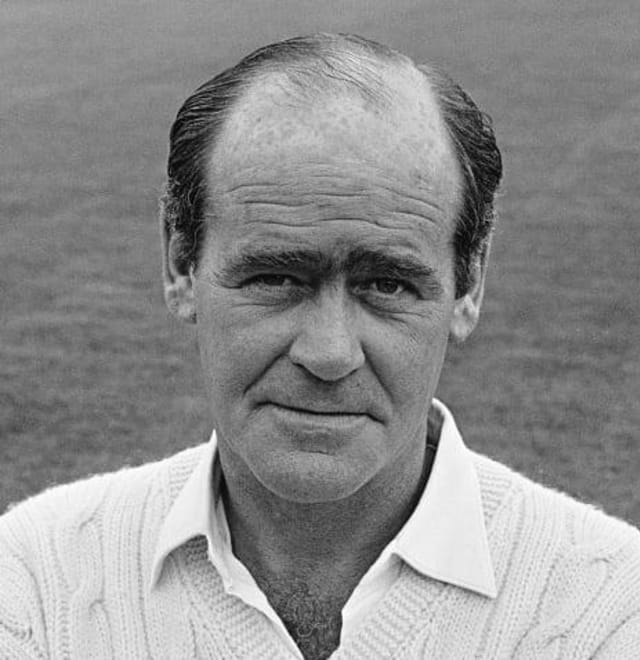
“Just as with England, though”, observed Stephen Chalke, “he found himself ousted from the side.
“Close arrived at Headingley for, as he thought, a pre-season briefing to be given the ultimatum of resign or be sacked.
“He chose to resign and moved across the country to Somerset, where he took over as captain of a side that went on to great success, particularly in one-day cricket, which is deeply ironic as it was his supposed opposition to the Sunday League that had prompted his dismissal from Yorkshire”.
Close took on a squad that included two future superstars of the game – Ian Botham and Viv Richards – and was hugely influential in their careers.
Stephen Chalke said that Close deserves to be remembered above all for his courage on and off the field.
“In 1976, at the age of 45 he was selected again for an England team that faced a brutal fast bowling attack of the West Indies.
“He was even asked to open the innings, something he had not done for many years and he and John Edrich underwent one of the most savage spells from Holding, Roberts and Daniel. The pair of them took blows to the body as they struggled to survive and saw out the day’s play – to reveal bodies once again covered in bruises”.
No-one ever doubted that Brian Close had the courage and determination needed – he was equally fearless fielding close in – and it was not bravado that he called his autobiography, ‘I Don’t Bruise Easily’!
Stephen Chalke finished by drawing the audience’s attention to Brian Close’s driving…not his driving of a cricket ball, but his accident-prone car driving.
“He drove a car like he played the game”, said Stephen, “at full tilt and with little regard for his own safety. Legend has it that he wrote off one sponsored car on the first drive back to Yorkshire!”
Close and Barnes were two cricketers who were always larger than life. Close outlived Barnes, who died in 1899 at the age of 46 only three weeks after his wife Eliza; Brian died in 2015 and will always be remembered as unflinchingly courageous, unapologetically obstinate and a daring gambler, both as player and captain, who was the epitome of positive cricket.
Nottingham Cricket Lovers Society meets monthly in the close season, usually on the third Thursday of each month. Membership for the 205/26 season is £20, joint membership £30 and visitors £10 per session.
The full programme of meetings and visiting speakers is available on the NCLS website - https://nottinghamcricketlovers.co.uk/
November 2025