Hardstaff’s Double Ton Record
Test Matches always bring milestones and anniversaries to the fore and this week at Trent Bridge, the Nottinghamshire faithful will pay tribute to one of their most stylish and accomplished batters, Joe Hardstaff jnr.
Eighty years ago, on 24 June 1946, Hardstaff scored 205no against India at Lord’s, not just the outstanding innings of his illustrious career but still the highest Test score for England by a Nottinghamshire batter.
In a stellar England batting order, it was Hardstaff and wicket keeper Paul Gibb that rescued England after the famed quartet of Hutton, Washbrook, Compton and Hammond had contributed just 67 runs between them.
The pair added 182 for the fifth wicket and after Gibb departed for 60, Joe shepherded the tail to take the home side to 428 all out and set up a win – by 10 wickets – that looked unlikely when he came into bat at 61-3.
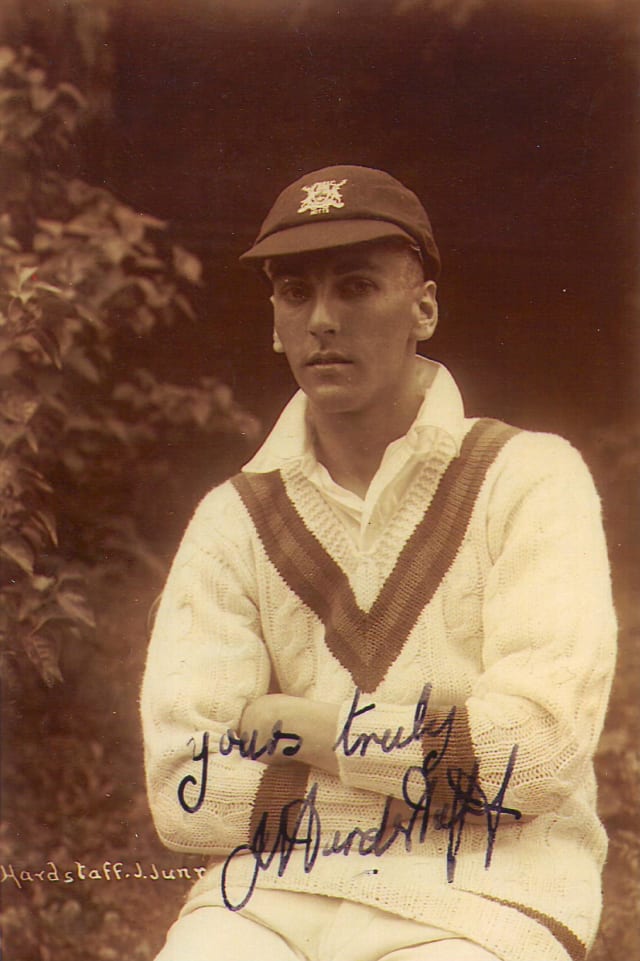 He batted for 318 minutes, faced 405 balls and hit 16 fours – and a five (presumably over-throws). Given his Test record, 1,636 runs at 46.74 with four centuries, he might have expected more than his 23 England caps; indeed, his Test average was, unusually, even better than his First-Class average, which stood at 44.35.
His record innings drew fulsome praise from the newspapers of the day – the only disappointment was that he got out just before the King, George VI, arrived to watch the game. But Joe did receive the King’s warmest congratulations when the teams were introduced.
As the Nottingham Journal gleefully pointed out, Hardstaff’s 205 surpassed the Indian team total by five runs and it was, they said, ‘a magnificent innings’.
The report highlighted how, with his, ‘delicate late cuts and forceful on-drives’ he ‘placed the ball…as he wished, varying his attack with all the strokes at his command’.
That sort of praise was typical of the view of Joe – ‘stylish’, ‘elegant’ were often used to describe his batting. He had an upright attacking style founded on strong defence and was described by E W Swanton as "one of the most stylish and gifted batsman of his generation".
Part of a great Nottinghamshire cricketing family, he surpassed his father (Joe senior) both in appearances for England and in First-Class centuries. His son, also Joe – they weren’t exactly imaginative when picking names – was also a cricketer, playing for the MCC and in a couple of First-Class games for the Free Foresters.
Along with his contemporaries, Joe Harstaff lost six years of cricket to the Second World War, otherwise he almost certainly would have extended his 83 First-Class hundreds to the coveted 100 mark. Curiously, one report on his Lord’s innings did suggest that the war-time cricket he had played while serving in India may have helped him deal with their bowling.
In his long career (he played for Notts from 1930-1955), he gained his county cap in 1931; was twice awarded a benefit season, in 1948 and in his retirement year; and was a Wisden Cricketer of the Year in 1938.
Playing against Kent at Canterbury in 1937, he made 126, the first hundred of which came in 51 minutes and earned him the Walter Lawrence Trophy for the fastest century of the season (it was also, in time, the fastest winner of the Trophy up to that year).
He still stands third – after George Gunn and Tim Robinson – in the list of all-time scorers for Notts with 24,249 career runs (his First-Class tally was 31,847) and tops the century-makers with 65 for the county (83 in total).
For the record, one ex-Nottinghamshire player has scored more for England but when Kevin Pietersen made his 227 against Australia at Adelaide in 2010, it was more than six years after his departure from Notts.
When England take to the field to meet New Zealand at Trent Bridge, 80 years and one day after Joe’s record innings, members and supporters will remember him and hope to see his great innings matched or even surpassed.
24 June 2026